CAREFUL BE VERY CAREFUL DRAFTING A WILL

CAREFUL BE VERY CAREFUL DRAFTING A WILL
Date: 24 Aug, 2022| Author: Fred Streiman

Almost every Will written in Ontario, and indeed in most jurisdictions, begins with the phrase or something close to it “I hereby revoke all Wills and testamentary dispositions of every nature and kind whatsoever made by me before”.

To the average person this simply means that any previous Will you made is canceled and replaced with your new will.  However, a testamentary disposition is far wider than a Will.  It speaks of what is to occur with respect to any asset upon one’s death. Think about that. That includes insurance policies, beneficiary designations in RRSPs and potentially placing a property in joint tenancy with right of survivorship.

The average person would think that the only way to change a beneficiary designation in a RRSP or life insurance policy would be by changing that beneficiary designation at the very institution where the insurance policy or RRSP was held. That is not the case. The Ontario Succession Law Reform Act sections 51 and 52, permit beneficiary designations and indeed changes and revocations to be made in one’s Will.

One must be very careful.  Generally in the Wills that we draft they contain a provision whereby their spouses are often named as their beneficiary of assets such as RRSP or TFSA.

When the “Full Monty” process is undertaken, this is not the case and we carefully must ensure that there is a consistent approach.  For information about the Full Monty simply use that search term on our website.

So what is the law in Ontario and indeed across Canada when we have a standard Will with a revocation/cancelling clause at the start of one’s Will when there is a prior beneficiary designation for registered assets such as an RRSP or TFSA?

In the 2021 decision by the Honourable Madame Justice Catriona Verner of Alger v. Crumb, a decision of the Ontario Superior Court of Justice, this very question was debated.

It is interesting to note that Justice Catriona Verner had only been sitting on the bench approximately a year when she released her decision.  Justice Verner came to the court with a very serious criminal law background, but not one in civil law and certainly not Wills and Estates. Nonetheless, her legal intellect was brought to bear in this decision and the author heartily agrees with the decision that she reached.

Alger v. Crump is a case dealing with a small estate. But the fact situation is almost universal and as such is an important decision. It reviews the law as this issue has come up a number of times across Canada. If your Will says I revoke my earlier testamentary dispositions, and a beneficiary designation of an RRSP is a testamentary designation, does that mean it’s canceled, does that mean the RRSP now forms part of the estate?

In this decision, Justice Verner had before her a number of decisions holding different positions across the country. She had the decision of Justice McIssac in McNaughton Automotive v. The Co-operators General Insurance.  We discussed in another blog article how that decision was clearly wrong. WHAT HAPPENS WHEN A JUDGE IS WRONG?

Justice Verner closely looked at sections 51 and 52 the Succession Law Reform Act. She also looked at the Ontario Court of Appeal decision in LaCzova Estate v. Madonna House.

The law as concluded by Justice Verner is that it is not enough to make a general sweeping statement revoking all testamentary dispositions.  To meet the provisions of the Succession Law Reform Act, the specific asset such as a RRSP, life insurance policy, RIF or a TFSA must not only be specifically referred to, but also the beneficiary designation that is now being changed must also be stated. Failure to do so means a general statement found at the opening of every Will has no effect.

Common sense, good law.

One must be very careful and appreciate the effect of standard clauses contained in Wills across the land. In Nova Scotia, there is no equivalent to sections 51 and 52 of the Succession Law Reform Act. Accordingly in Nova Scotia, such a general opening phrase will cancel an earlier beneficiary designation.

Quite frankly this demonstrates, that using a Will kit or having a Will prepared by a lawyer that does not specialize in Wills and Estates can be an example of playing with fire.


Can a Power of Attorney be used for entering into a Trust Agreement including the Fully Monty Pt 2

dale (2)
Date: 21 Jun, 2022| Author: Fred Streiman

In another blog article we reviewed the unhappy fact situation set out in the Selkirk case

The court examined the law on whether or not individuals using a Power of Attorney can enter into a Trust Agreement on behalf of the donor of the Power of Attorney. There were three competing decisions across Canada. However, the theme of those three decisions is exactly in accordance with our firm’s own practice. An attorney can only do those things that are in strict accordance with the terms of an existing Will and as such are not creating a testamentary document, (usually a will).  In plain English, you cannot use a Power of Attorney to write a person’s Will. This is both prohibited under the common law i.e. judge-made law and under the provisions of The Substitute Decisions Act.

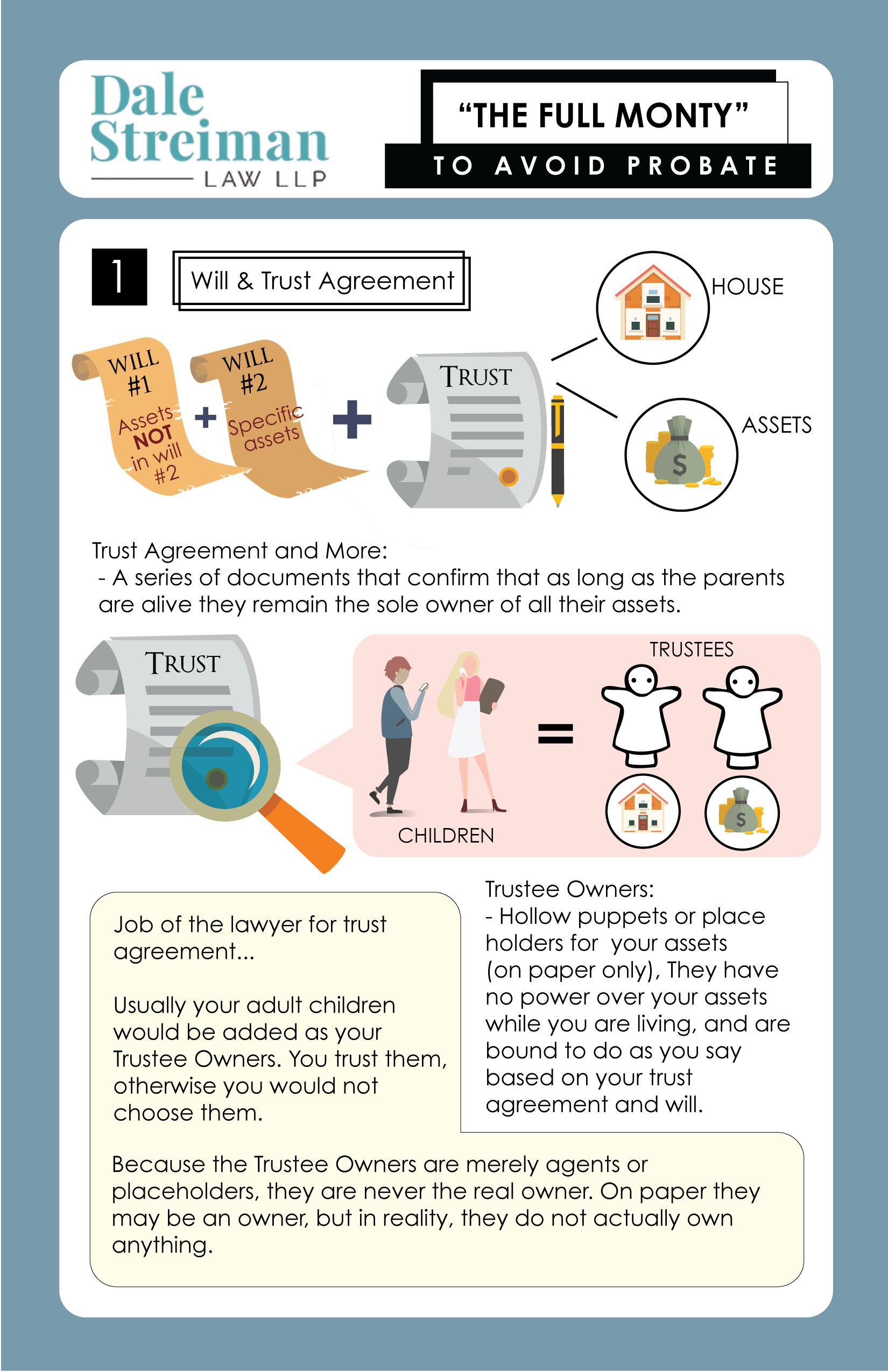
But you can create a Trust such as the ones we commonly do under the Full Monty using the Power of Attorney if it is completely in accordance with the Terms of an existing will.  You can facilitate the terms of the will, but you cannot change its terms or effect.

TRUSTS AS A MEANS OF SKIPPING PROBATE and USING A POWER OF ATTORNEY TO SIGN ON BEHALF A MENTALLY INCOMPETENT PARENT

TRUSTS AS A MEANS OF SKIPPING PROBATE
Date: 17 Jun, 2022| Author: Fred Streiman

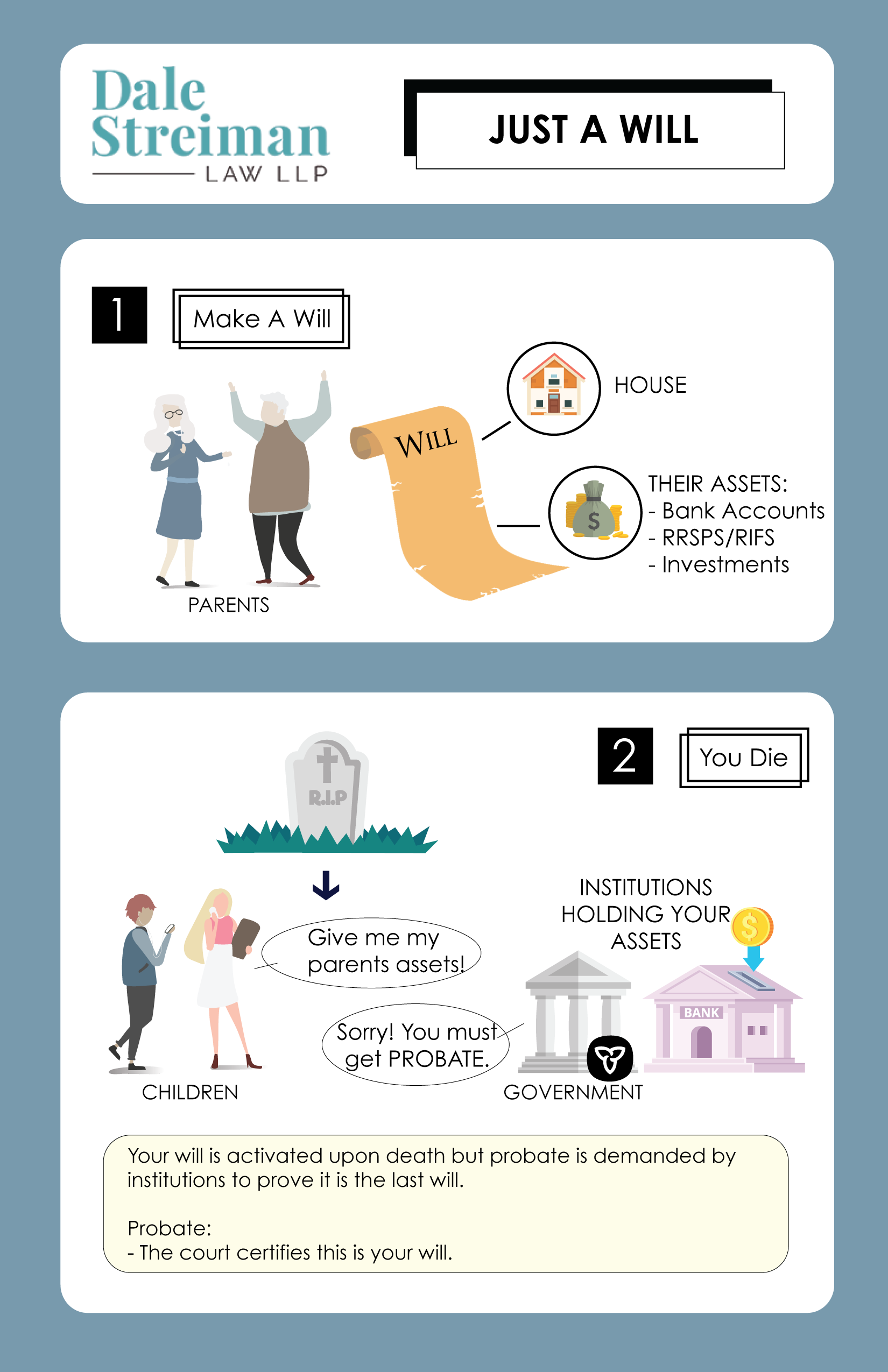
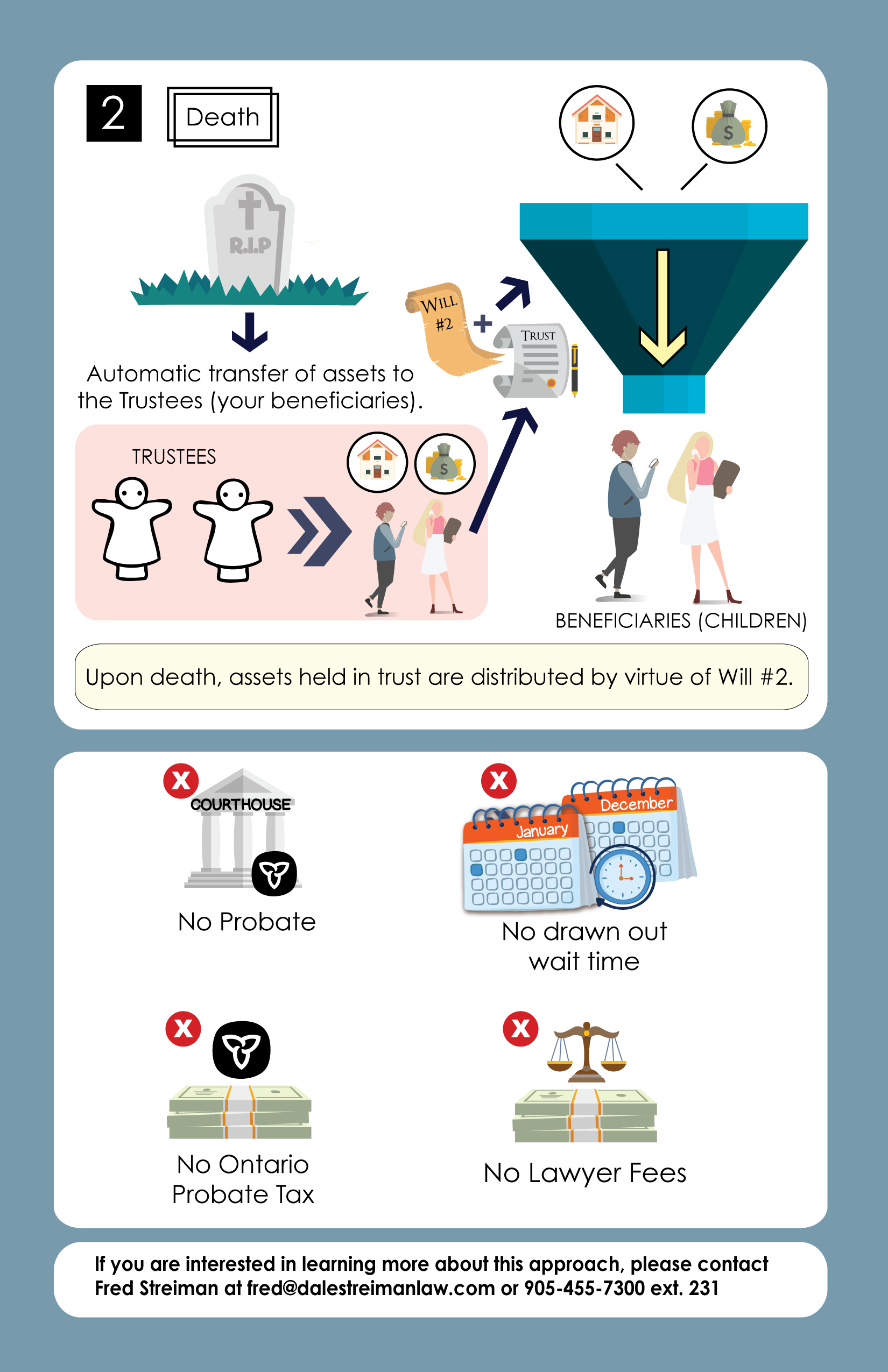
At our law firm we have devoted a fair amount of time to perfecting our strategy to avoid or eliminate probate. We have called that strategy the “Full Monty” and it is explained elsewhere on this website.

Learn More : A Strategy To Reduce Or Eliminate Probate Fees – Fully Monty

Learn More : The Full Monty

In the May 2, 2022 decision of Madame Justice Sally Gomery of the Ontario Superior Court of Justice she explored this issue.

Sheila Selkirk died and left behind a set of dysfunctional children. What should have been resolved over a cup of coffee instead became a long winding road of disharmony, distrust and division.

Some interesting and novel legal arguments were made, but quite frankly from this observer’s perspective, the position being taken by the unhappy beneficiary siblings was a loser from the very start.

However, the case does stand for the proposition that properly appointed attorneys under a Power of Attorney for property can enter into a trust declaration for property owned by a mentally incompetent donor. That is more fully explored in our Blog titled  – Can a Power of Attorney be used for entering into a Trust agreement including the Fully Monty.  That is more fully explored in our Blog titled – Can a Power of Attorney be used for entering into a Trust agreement including the Fully Monty

Let’s break this down into a concrete example such as in Selkirk so that one can understand this legal mumbo-jumbo. We have a widow who owns a house and she has a number of children. She already has a Will in which while she largely divides her estate equally amongst her children, but she wants a loan made to one of the children to be repaid before they get their share. The mother told a few of her children that she wanted to avoid probate and its expenses.  However the mother lost her mental capacity shortly before she died and was not able to sign anything.

The brothers went to see their lawyer who prepared a Trust Agreement. The Trust Agreement unfortunately was far briefer and less detailed than the document that our office prepares. The Trust Agreement simply indicated that two children were to be added as joint tenant owners of the home in addition to the ailing mother. The brothers using the Power of Attorney granted to them signed on behalf of their ailing mother. The trust declaration simply indicated that their mother remained the sole beneficial owner, but did not say what was to happen upon her death.

The unhappy beneficiaries after mom died tried to argue that she had explained and promised to all that when she died she wanted her house sold and the net proceeds simply divided equally amongst all of the children.

This argument was doomed to fail from the begin.  Nothing was in writing, the Will was not changed nor could the mother’s existing Will have been changed at this stage of her life.

The case is littered with terrible cross allegations between the siblings of theft and other misdeeds and one cannot but help be saddened and shake their head over a family torn apart over a modest amount of money. The house in question upon sale only realized $326,000.  Divided among six people, this is hardly life-changing. On the other hand, it does provide an interesting factual backdrop, but at what emotional expense.

Why at times Primary and Secondary Wills are Crucial

dale law
Date: 09 Jun, 2022| Author: Fred Streiman

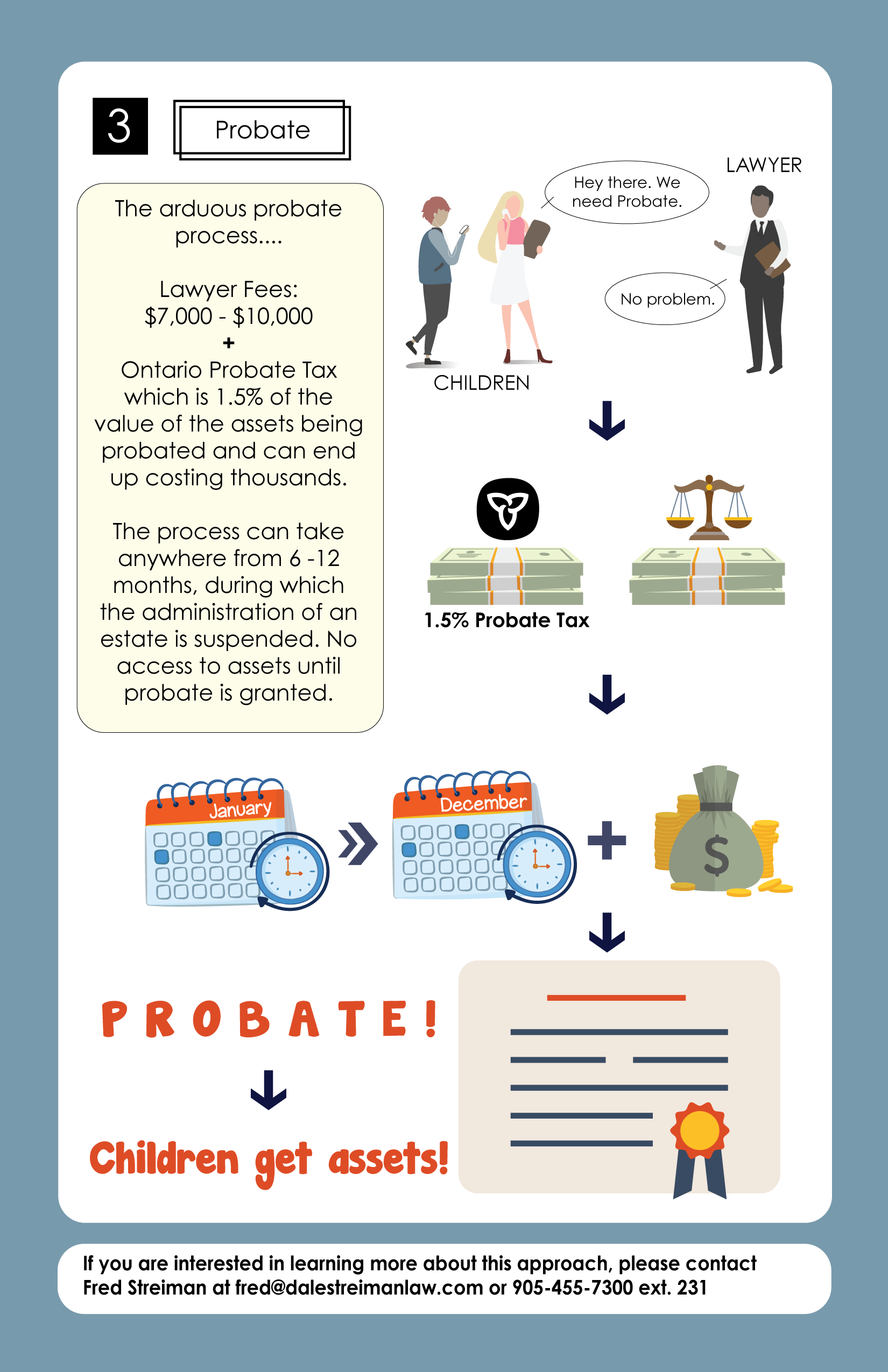
In late 2021, Justice Nicholson of the Ontario Superior Court released his decision in Greaves Estate vs. Ontario (Ministry of Finance). Mr. Greaves died far earlier than anyone had anticipated. At the time of his death, he controlled three corporations ( not listed on a stock exchange ) and they were the beneficiary of a number of life insurance policies. As a result of his death, the insurance policies death benefits were paid to the companies, the shares of which Mr. Greaves solely owned. The estate now had these insurance proceeds within its four corners and the question became what assets were to be declared when probate is sought. The larger the value of the estate the greater the estate administration tax that the Province of Ontario will levy. That tax roughly speaking is 1.5%. As we discussed earlier, that is a tax that is completely separate and apart from any federally levied income tax. There was much discussion and debate before the court and in the end, the court would not allow the executors of the estate the right to even seek an answer to the question as to whether or not the insurance policies and accordingly the value of the shares should be included for the purpose of calculating the estate administration tax.

The unspoken practical answer is that this never should have been a question. Properly drafted Primary and Secondary Wills would have lumped the shares in a privately held corporation in that portion of ones estate that does not require probate and as such is not subject to the estate administration tax. Just a little bit of estate planning would have gone a long way and would have saved both much money and aggravation in this situation.

Our office regularly prepares Primary and Secondary wills, often as part of a probate avoidance process we call the Full Monty. Details of the Full Monty can be found on our website.

To learn more check out the article – A Strategy To Reduce Or Eliminate Probate Fees – Fully Monty

To learn more check out the illustration – The Full Monty

A CAUTIONARY TALE WHEN OPENING UP AN ONLINE INVESTMENT ACCOUNT

Date: 29 Mar, 2022| Author: Fred Streiman

Increasingly with our online world, our clients are taking advantage of opening up online stock trading accounts. Wishing to save the fees charged by normal investment and brokerage houses, parties are taking advantage of offers of almost minimal commissions offered by companies such as Questrade.

It is crucial that when couples open up such an account they appreciate the difference between joint tenancy and tenants-in-common. We link our blog article on that subject here as it bears careful reading.  Joint Tenancy vs. Tenants-In-Common There is a vast difference and the failure to appreciate those differences can have very expensive consequences.

In one particular case, a husband and wife opened up an online account with no human interaction. After the death of one, they learned that the account had been opened in tenants-in-common rather than joint tenancy as they had wished. The net effect was that the surviving spouse needed to apply for probate and pay the significant legal fees and estate administration taxes that were thusly triggered.

JOINT TENANTS vs TENANTS-IN-COMMON

Date: 29 Mar, 2022| Author: Fred Streiman

There is no more basic yet more misunderstood term in real estate than the difference between joint tenancy vs. tenants-in-common.

These are the two most common methods for multiple people or companies owning a single property. There is a vast difference between the two, despite the similarities in their names. Joint tenancy  or Joint Tenants means there is an automatic right of survivorship between the multiple owners. If two or more people own a single property as joint tenants, upon the death of one of them, their ownership interest automatically flows to the others irrespective of the deceased’s Will. Far and away the most common example is that of the family home. The vast majority of couples purchase their homes and take title as joint tenants. Upon the first of the spouses to die the other becomes with very little legal work or formality the sole registered owner of that property. One’s Will has no effect and is irrelevant.

Tenants-in-common has no right of survivorship. When one of the multiple owners who hold a property as tenants-in-common dies, their interest goes wherever their Will says it goes. This is appropriate for business or partnership relationships. Tenants-in-common permit different percentage ownership interests in a property unlike joint tenancy.   In Joint tenancy every owner must have the same percentage ownership

The difference is immense and careful attention needs to be paid to this.

Severing Joint Tenancy

ODSP and Estates HENSON TRUSTS

ODSP and Estates HENSON TRUSTS
Date: 31 Jan, 2022| Author: Fred Streiman

Elsewhere in our blog articles, we have discussed the creation of a Henson Trust. What happens if the testator/willmaker never created one? This can happen for various reasons, including where the deceased left no Will or if the disability took place after the Will was prepared. Sometimes, the willmaker fails to reveal to the lawyer the existence of a beneficiary’s physical and mental state.

Generally speaking, there is a $10,000 limit for receipts from a Henson Trust before any negative impact upon ongoing entitlement to ODSP, the Ontario Disability Support Program.

It is not uncommon for this situation to arise.  What can estate trustees do to try and mitigate the negative effect upon a beneficiary’s ongoing receipt of ODSP. Remember that an inheritance is considered by the provincial government in determining the beneficiary’s ongoing entitlement and quantity of ODSP payments. There are several strategies that can be looked at and here are only some of them:

  1. There is firstly a $40,000 basic exemption in which one can have assets of this amount with no negative impact upon one’s ongoing entitlement to ODSP.
  2. One can use the funds to purchase a principal residence for the beneficiary, a vehicle or some product that is related to the recipient’s disability. While this sounds like an excellent idea, frequently if a person is so disabled as to be entitled to ODSP, the purchasing of a residence may not necessarily make sense.
  3. Another method is the ODSP existing restrictions permit an additional $100,000 segregated fund or trust being created for the beneficiary’s maintenance and support. It is almost as if retroactively a Henson Trust is being created for an individual, however it is now restricted to having no more than $100,000 within it.
  4. There are also various expenses that are not related to disability that one can seek pre-approval from the director of ODSP to allow those expenses to be paid without impacting ones’ ongoing entitlement to ODSP.
  5. Improving the ODSP recipient’s living condition by getting pre-approval from the director of ODSP. This could be used to renovate of the residence of the ODSP recipient, including furniture and perhaps even vacations for the beneficiary and even their personal care workers.

This area is extremely complex as involves the intersection not only of law but as well a government agency which is permitted to change its rules at its discretion. There are many learned papers on this topic which are beyond the scope of this blog. I would recommend for those parties that wished to further explore this area to look at the excellent paper contained within the 2021 Estates and Trusts Summit.

HENSON TRUST

HENSON TRUST
Date: 24 Jan, 2022| Author: Fred Streiman

It is not uncommon for the average person to have heard of a Henson Trust, but not to have understood its meaning. A Henson Trust is named after a 1989 case involving the will of Leonard Henson of Guelph.  The provisions of that will was challenged and eventually led to an important decision that held that a Henson Trust was a valid method of assisting a disabled beneficiary while not impinging upon their ongoing receipt of Government assistance.  The most common example of that is ODSP, the Ontario Disability Support Program.  Legally the validity of a Henson Trust was given the “Gold Seal of Approval” by the 2019 Supreme Court of Canada case of S.A. v. Metro Vancouver Housing Corp.

The general concept of a Henson Trust is for the testator/willmaker to set aside a fund for a disabled beneficiary, but do it in a fashion in which the fund never belongs to the aimed beneficiary and the dispersal of funds is completely at the discretion of the trustee in charge of the Henson Trust. Generally speaking, the executor of the Will will be that trustee. A prime example of a Henson Trust is for an adult child who suffers a disability and is unlikely to ever become financially self-sufficient and the willmaker does not wish to harm the ongoing entitlement of the adult child to ODSP. The amount of ODSP varies with time and is set out in the regulations to the Ontario Disability Support Program Act. At the time of writing, an individual living independently and having no dependents will receive a total payment of $1,169 per month. Hardly enough to support a lavish lifestyle.

What is a parent to do to in an effort to achieve the goal of making provisions for their child, but not harming their ongoing entitlement to ODSP?  A Henson Trust is the common method of doing this for the adult child is inheriting nothing and has no entitlement to any benefit in the Henson trust. Whatever they receive is completely at the discretion of the Trustee.  These are extremely common, and it is important that you discuss this issue with the drafting lawyer.

One of our standard opening questions is about the mental and physical health of all parties within the family to alert ourselves as to whether not any special provisions need to be made in one’s Will, including a Henson Trust. Clearly critical is having complete trust in the Trustee/Executor to do the right thing for the beneficiary child.

Strategies when a Henson Trust was not created, can be found in our blog titled ODSP – WHAT TO DO WHEN THE RECIPIENT RECEIVES A SHARE IN AN ESTATE

IS PRINTING YOUR NAME A SIGNATURE

IS PRINTING YOUR NAME A SIGNATURE
Date: 10 Jan, 2022| Author: Fred Streiman

Is printing your name the equivalent of signing a Will for the purpose of creating a valid Will?   This blog article must be looked at taking into account the substantial compliance rules that will be in effect in Ontario as of January 1, 2022.  Substantial compliance means as long as the court believes that a document is an accurate reflection of the willmakers intention then it may very well be deemed to be valid by the court.  In simple language, minor errors can be fixed by the court. That has not been the law up until now.

In the 2021 decision in BMO Trust v. Cosgrove, a highly experienced Wills and Estates judge, Madame Justice Dietrich held that printing one’s name is not a signature. Section 4 of the Succession Law Reform Act specifically requires a signature and where it must be placed. It also requires the two witnesses to subscribe to their names. It is interesting that the Act used a different verb, to “subscribe” rather than “sign” for the witnesses as opposed to the willmaker. Subscribe has many different definitions and can be referred to as a simple synonym for signing. Why endure the uncertainty and the legal fees when one simply has to follow the basic rules set out in the Succession Law Reform Act. Again, your lawyer will know this. Trying to do a Will yourself is clearly an exercise in being penny-wise and pound-foolish.